The full founder letter
Built by the Boss who needed the system first.
Why this exists, what changed, and what I want for you.
Founder note
This is the one page on the site where I drop the product voice and write to you directly. I'm Aaron C. Ernst. I founded BossMode because I kept seeing the same problem in my own business: AI made me faster, but I was still the routing layer for everything.
If you only read one line of this essay, read this one. Stop using AI. Start installing AI employees. That's the whole pitch. AI automation is the category. AI employees are the way BossMode makes it concrete: bounded roles with business context, rules, approvals, tools, and owner reporting.
Chapter 01
Why is now the inflection?
I started a business to own something. I ended up running it.
Every owner-led company hits some version of that trap. You hire people, add software, document SOPs, wire automations, and somehow the business still waits on the person with the most context. The owner answers the weird questions. The operator remembers the edge cases. The team asks, “Where does this go?” The work technically has tools, but it does not have ownership.
AI changes that only if you stop treating it like a tab and start treating it like a role.
A normal automation moves data from A to B. A generative AI automation can read, draft, summarize, route, decide inside rules, ask for approval, and report back. That is why the language matters. BossMode builds AI automations, yes. But what the business feels is an AI employee taking over a repeat-work role without taking away owner control.
The architecture shift
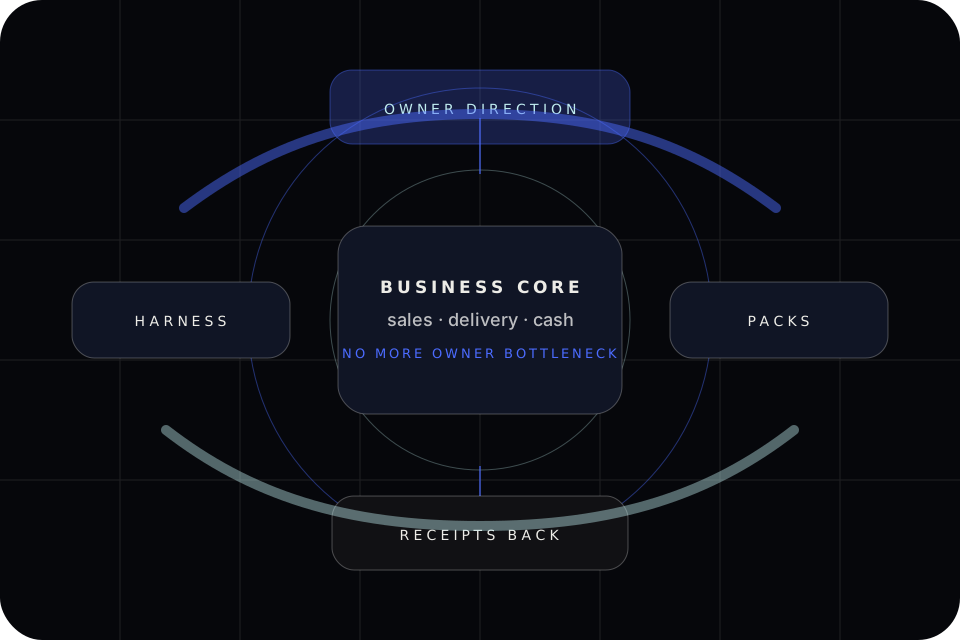
From AI as a tool you open to AI running things for you.
The Boss gives direction. The AI tools you already use execute. Packs carry the standing orders. Results come back before another decision gets made.
Chapter 02
What BossMode is
BossMode installs AI employees for growing owner-led companies.
An AI employee is not a vague bot. It is a bounded operating role: AI receptionist, AI sales assistant, AI project manager, AI content operator, AI owner reporter. The system gets loaded with your offer, voice, customers, tools, examples, rules, approval paths, and escalation conditions. Then it runs or prepares the repeat work that used to boomerang back to the owner.
The fit is companies with real operating volume: usually businesses doing meaningful revenue, dealing with repeated handoffs, missed follow-up, reporting drag, quote delays, stale pipeline, project slippage, or owner-dependent admin. Small businesses are not excluded. They just need an expensive enough leak — one recovered client, job, quote, or deal should be able to justify the system.
Chapter 03
What did the old way actually look like?
Here's the architecture most owners are stuck running, whether they say it out loud or not.
There's a business at the core. The business has a sales motion, delivery motion, cash motion, support motion, and reporting rhythm. On top of that core, the owner stacks AI tools one tab at a time. ChatGPT is open for emails and outlines. Claude or Cursor is open for technical work. Make, Zapier, or n8n is wired into automations. A notes app is full of prompts the owner is afraid to lose.
Layered like that, it looks productive. It is, marginally. The cost of producing a single email drops. The cost of writing a draft drops. The cost of summarizing a call drops. But the architecture does not change if the owner still has to remember, route, check, approve, and follow up on everything.
That was me. More AI, same operating drag.
The fix was not buying one more tool. The fix was assigning roles. If follow-up matters, install an AI sales assistant. If projects stall, install an AI project manager. If reports eat the morning, install an AI owner reporter. The point is not more output. The point is repeat work moving with context, rules, and an escalation path.
The method
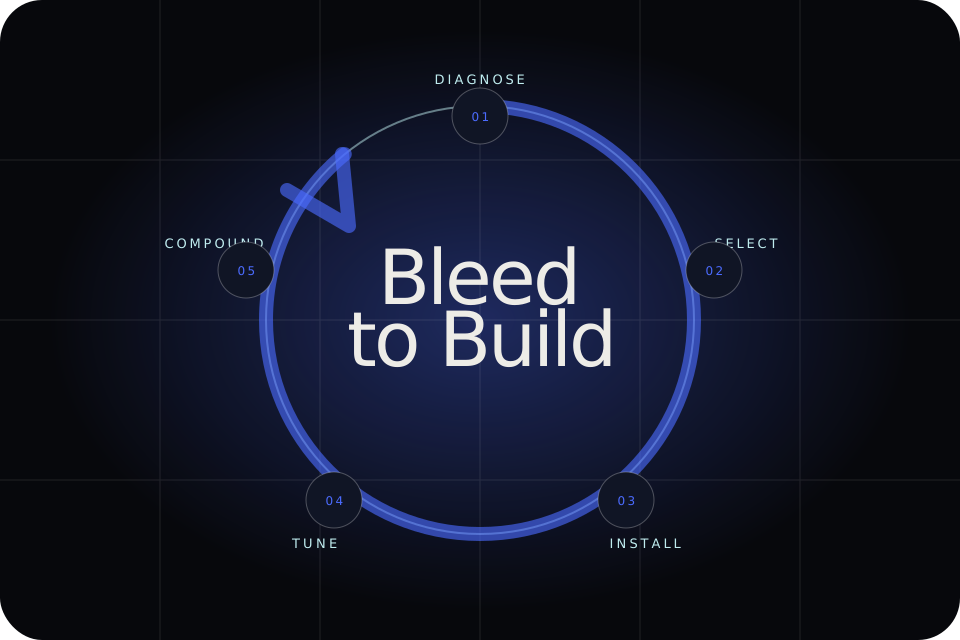
Diagnose, select, install, adjust, get smarter over time.
The loop is what keeps this from becoming another pile of tools. Every Pack has to name the leak, run the recipe, and clear runway for the next system.
Chapter 04
What changed when I pivoted?
The pivot was small to describe and total in effect: I stopped asking AI to help with tasks and started writing standing orders for roles.
A standing order defines the work, the context, the inputs, the tools, the voice, the rules, the approval boundaries, the stop conditions, and the report-back rhythm. Once that exists, AI stops being a clever assistant and starts becoming an operating layer.
That is what BossMode now installs. Sometimes the install uses prompts. Sometimes it uses automations. Sometimes it uses forms, CRMs, email, docs, voice agents, or dashboards. The surface can vary. The principle does not: the AI employee owns a repeat loop, the owner keeps the rules and final say, and exceptions escalate instead of silently drifting.
This is the difference between “we use AI” and “a piece of the business runs on AI.”
Chapter 05
Do we run our business on it?
Yes. We run BossMode on BossMode on purpose.
The AI Employee Roadmap exists because we built a diagnostic system to map where repeat work is leaking time, leads, and money. The site copy, proof library, pricing work, CRM follow-up, and internal operating reports all move through versions of the same philosophy: assign the role, load the context, set the rules, inspect the output, improve the standing order.
I do this for one reason: I refuse to sell AI automation as magic. If the system cannot survive my own business, it should not be sold into yours.
We do not have a wall of polished customer case studies yet. So the proof standard has to be honest: demo workflows, before/after maps, sample owner reports, visible operating receipts, and clear claims about what is proven versus what is projected. I would rather show the machinery than pretend a fake case study is proof.
The standard
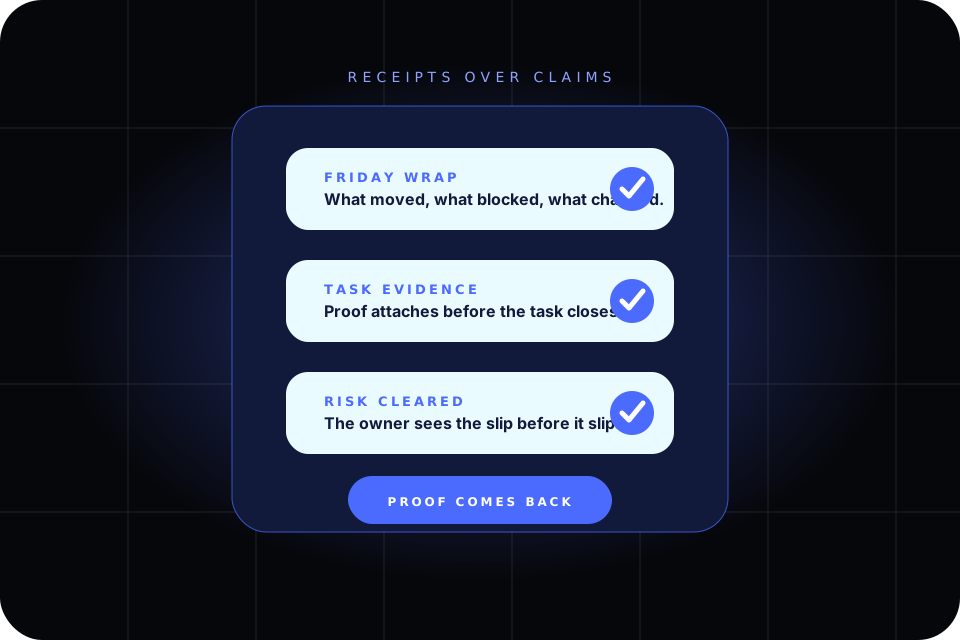
Results beat vibes.
If the work moved, there should be evidence. If the Pack is working, it should show up in the ledger, the wrap, and the operating picture.
Chapter 06
Does this generalize?
Yes, because the architecture problem generalizes.
Every growing company eventually has repeat work that is too expensive to keep dropping and too contextual for a simple trigger-action automation. Sales follow-up, quote nudges, project updates, client reporting, content repurposing, intake routing, internal summaries, and owner dashboards all have the same shape: context matters, rules matter, and the work needs a named owner.
That named owner does not always need to be a human. But it cannot be an unsafe black box either.
BossMode sits in the middle: practical AI automation packaged as AI employees. They answer, follow up, draft, organize, report, and escalate. You keep the rules, approvals, and final say.
Chapter 07
Why am I the one writing this?
Because I'm the owner who needed it first.
I'm not a venture-backed founder pretending to know what operating pressure feels like. I run the company. I sell the engagements. I write the systems. I take the calls. I am accountable when an AI employee does not survive contact with the real business.
BossMode came out of a real ledger, not a pitch deck. The offer gets sharper as the work proves itself. The company exists to help owners stop being the routing layer for work that should already have a role, a rulebook, and a report-back rhythm.
If that lands, here's where you go next.
Start with the AI Employee Roadmap.
Four minutes. We map the repeat-work leak and name the first AI employee worth installing.
Start the AI Employee Roadmap →
If you'd rather do the homework on your own first, start with the AI Employee Roadmap — twelve diagnostic questions, free, no card.
— Aaron C. Ernst, Founder, BossMode
Where to go next